


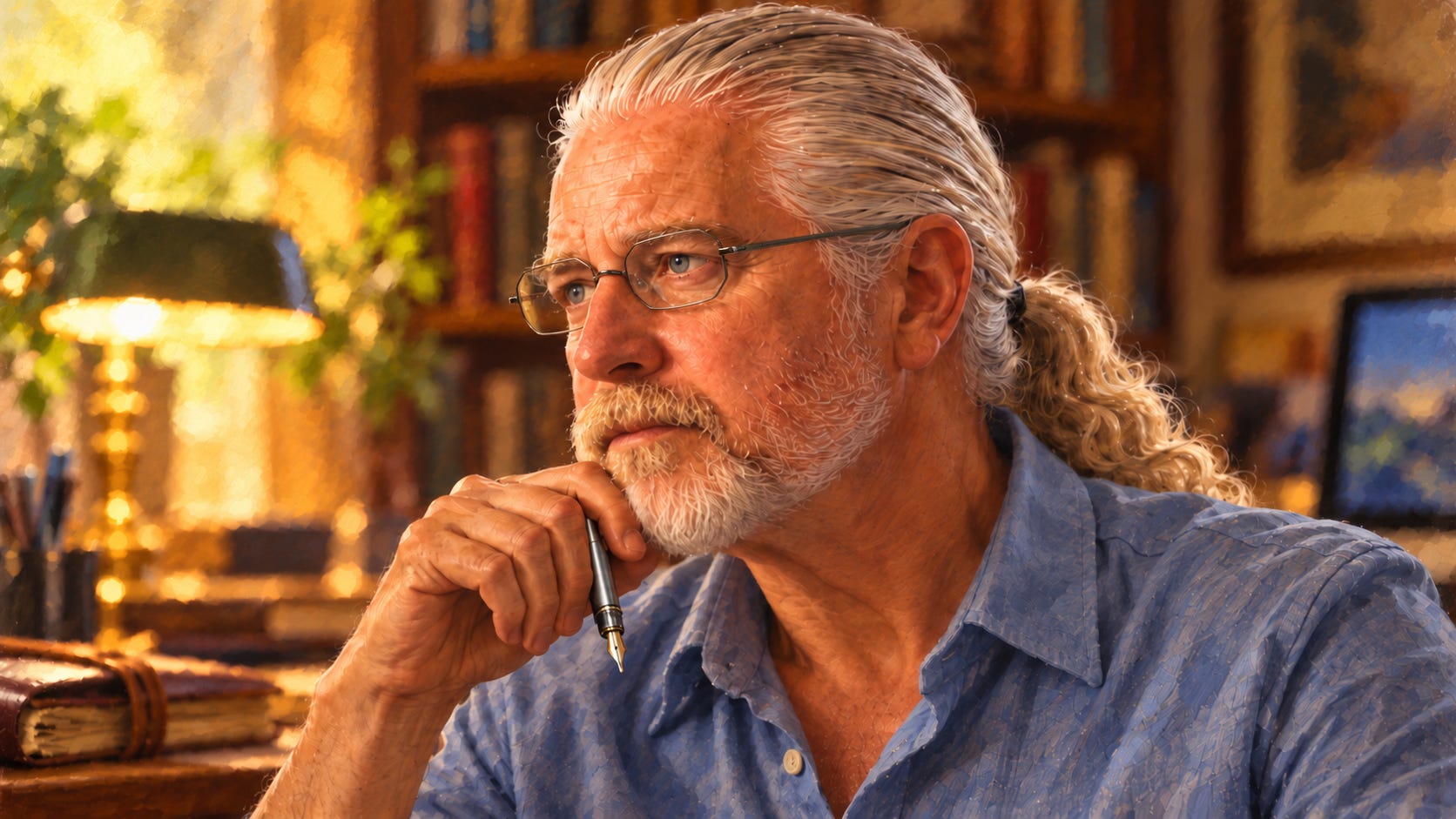
You may be wondering who I am. Cool. We already have something in common. I spend an inordinate amount of time trying to figure out that same thing.
Another thing I spend an inordinate amount of time doing is writing. In fact, writing is the primary means I use for the other “inordinate amount of time” project. Writing, I realized early on, is as much a royal road to discovery as reading.
So that’s where I start. Although I’ve never really thought of myself this way until quite recently, I’m a writer. And I have been all my life. Starting in the 1960s — which began less than two years after I was born — I scribbled out stories about Snoopy and the Red Baron to accompany the escape maps I drew for Snoopy to use when he was inevitably shot down behind enemy lines. As a teen, I wrote poetry. One of my favorite poems — about breaking up with a girlfriend I didn’t have — came to me when, while writing something else, I looked for a word for “death” in the thesaurus and came across “The debt which cancels all others.”
The guy who came up with that great line was the 19th-century English cleric and writer Charles Caleb Colton. He published it in his famous collection of aphorisms, Lacon: or, Many Things in Few Words, back in 1820. It was such a powerful aphorism for death. So it frequently found its way into older editions of Roget's Thesaurus — being the younger version of the older guy I am today, I owned the older editions — under categories like “Death” or “Payment”.
But, as I often say — having stolen the line from my friend Scott Greenfield, who probably stole it from someone else, as writers often do — I digest. Geez. I even did it while doing it. I double-digest!
Anywayser, if you’d like to see the poem my teenage self built around the line, you can find it on my personal website where I’d intended to write until I learned about Substack. I won’t take up space quoting the entire poem here.
For years I wrote poems and even sometimes just fragments.
                                               Worlds Within
My mind's demons
bothered me
in my sleep.

And in my waking hours
they said,
"come play with us—
let us take you
to places unknown
worlds unseen
inside you."

So I went.
I must’ve been temporarily lost there because for a long time I wrote nothing but occasional letters. I ran away from home when I was seventeen. Shortly thereafter — with my father’s help — I joined the Navy and turned eighteen in boot camp. I served aboard the USS Anchorage (LSD-36) and have all my life been tickled over the hull number. I’ve done a lot of things in my life, but the closest I came to doing drugs was not doing any, but serving aboard one.
Trust me. That was enough of a trip for me. (Although sometimes I wax nostalgic for the clandestine diethyl ether parties we held at sea. I wonder how much of that drum is left from the old surgical store? Well, probably none now that I think of it: my LSD-36 was decommissioned in 2003 and appropriately sunk as a practice target in 2010.)
When I returned from the hell that was my tempestuous tour aboard Anchorage from San Diego to the Philippines (where I spent some nights in custody after starting one of those famous riotous bar scenes you might see in Donovan’s Reef or The Cockleshell Heroes) to real life, I found I needed a lot of straightening out. I turned to writing. In 1980, I started the lifelong practice of journaling. In retrospect, what amazing — not even on a sammich! — journal entries were never birthed because I didn’t start while berthed on the Anchorage.
My journals were pretty amazing — despite not even on a sammich — nevertheless. I wrote about anything from someone who irritated me to someone I thought I loved (and was wrong about) to dreams and nightmares to books I argued with to a God I prayed to, later questioned, then rejected to what computers were doing to us to how language shapes what we think to how a brain manages to be someone — and why being that someone was sometimes so damned difficult.
From 1980 through at least the mid-to-late 1990s I journaled hours at a time. And while I didn’t journal every day, a month might hold two-thirds of those days being journaling days. And occasionally a journaling day held three different entries; August 8, 1989 had five! (I might have a little OCD accompanying my ADHD: all my journal entries have timestamps in addition to the dates, even though most journal entries were handwritten.) My journals frequently served as my “private therapist” — and I even wrote as much in an entry from December 1, 1990, where I explored aspects of myself that I called “Lover,” “Little Boy,” and “Mr. Intellect,” in addition to another voice I identified as “The Therapist.”
Whoa. OCD, ADHD, and multiple personality disorder?!
From 1983 through 1985 I was learning sign language, dreaming in signs, and I wondered whether signing was changing how I processed information — I would later wonder the same thing about my time as a medical transcriptionist, with words coming in my ear, out my fingers, and not spending much time in between — and this is the period where I extensively questioned gods and their institutions. (And, by the way, I attended a Freewill Baptist college for two years to study Greek and Hebrew, tolerated but warned not to “fraternize” with the female students.)
In 1989, my writing focused on computers, corporate power, alienation, losing control over my life — which I generalized to “us losing control over our lives” — and distinctions between memory, mind, and consciousness.
From 1989 to 1994 — I entered California State University, Fresno in 1989 and graduated in 1995 — I developed philosophical arguments about consciousness, ethical responsibility, religious identity, racism, and freedom, alongside intimate accounts of my own loneliness and relationships. Loneliness so severe that I wrote several short stories that focused on solipsism.
Five years at Fresno State was only made possible because by then I had my own medical transcription business. The work occupied about 3-4 hours a day and paid very well. When I’d left behind being a Hospital Corpsman in the Navy, I transitioned to an Emergency Medical Technician — the only veteran benefit I’ve used so far in my life was to obtain my EMT certificate from Visalia’s College of the Sequoias. But I quickly learned that you could make $X from taking care of a person and ten-times-$X for taking care of a person’s medical file.
And I’ve always admired the chain of what I call my accidental life.
Being a medical transcriptionist led to owning my own medical transcription service which led to owning Macintosh computers and funded my college education, which caused me to be exposed — before it was ever commercially available to the public — to the Internet because of my interest in cognitive science and philosophy of mind which led to learning to connect Macs to the Internet to train neural networks (thanks, Rumelhart & McClelland!) which led to eventually spending time with people like Steven Pinker, Paul & Patricia Churchland, Jerry Fodor — with whom I spent a half-hour sitting and drinking on a couch discussing George Rey’s work — among others which led to trying to choose between a linguistics, or anthropology, or philosophy degree and finally settling on philosophy which led to finding out the Fresno Bee had not one ad for philosophy jobs which combined with realizing I needed a new Internet connection and so led to helping build Cybergate and Protosource Network — the first two ISPs in Central California — which led to becoming the Director of Information Systems (eventually) for Valley Yellow Pages which led to Jim Varon, the in-house attorney, convincing me to go to law school, which led to today, where I sit near the end (I hope) of a 20-ish-year career as a criminal defense lawyer.
Phew!
I did not immediately — in fact, not for a long time — accept Jim’s suggestion that I go to law school. My position at VYP meant that Jim and I frequently lunched together and became fast friends. He often said, “Rick, you really would make a great lawyer. You need to go to law school.” This came during discussions of my concerns about “ageism” and being “stuck” at VYP. Younger people coming to work in my department were born with computers. I got my first one at the age of 28.
One day, when Jim brought it up for the umpteenth time, I said, “Jim, I can’t go to law school” — we’d been talking about San Joaquin College of Law, a local school that catered to night students — “by the time I graduate, I’ll be 48 years old.”
“How old will you be in four years if you don’t go to law school?” he asked.
That’s how I became what I came to call the Accidental Attorney.
A blog post — and, by the way, I’ve talked about journaling, but blogging also occupies a huge space in my writing “career” — on March 16, 2010 fleshes this out in greater detail. ChatGPT wants me to cut all this, but bear with me: I think it reveals a lot of what constitutes Rick Horowitz, So Far, even if there is a little repetition.
In truth it is an accident that I became an attorney. There’s no denying that fact. But my becoming a criminal defense attorney is no accident. That was a conscious decision.
— Rick Horowitz, Garbage In, Garbage Out: Becoming a Criminal Defense Attorney (March 16, 2010)
And later in that same post I furthered the point:
To this day, I don’t know why that question won the argument, but it did. Probably because there was a part of me — insanity runs in my family, I’ve heard — that always wanted to be an attorney. If I didn’t come from a family of lawyer-haters, I probably would have gone to law school many years earlier.
Jim warned me — the man had great insight and prescience — not to tell anyone at work that I was going to law school. He said it would certainly lead to me being pushed out of the company prematurely. Ultimately, Jim was right, although I think I have to take some blame (or credit, however you want to view it) for my ultimate departure. At any rate, after that conversation, I immediately signed up for law school, kept my secret until I was “outed” near the end of my second year and managed to hang onto my pseudo-job until I was ready to start clerking for a local criminal defense lawyer.
The pay drop was astronomical — and I do mean ASTRONOMICAL! — but in the end, I felt much better for it.
— Rick Horowitz, Garbage In, Garbage Out: Becoming a Criminal Defense Attorney (March 16, 2010)
Søren Kierkegaard — one of my favorite existential philosophers and, if you haven’t figured this out yet, this essay reeks of existentialism — once said, “life can only be understood backwards, but it must be lived forwards.”
For virtually my entire life, I stumbled from one thing to another. I hope this was clear from my “which led to which led to which led to” paragraph — hell, it was one sentence — above.
And, then, while in law school, I made a decision. I had gone to law school from a high-level tech position. I haven’t even gotten into the details of how high-level I was — editing and writing tech books, flying around the country on my “vacations” from VYP teaching engineers and earning thousands per week when I did — which is why my pay cut when I became a lawyer was, as I said, “astronomical.”
But one day, another lawyer — who was then a fellow student whom I won’t name because she gets upset when she hears my version of this story, claiming it isn’t true (but it very much is and I swear on my dead Rivka’s grave, which is in a box on my credenza that I greet every morning when I dress for work) — during a class discussion of a case that was intended to teach us the legal meaning of “willful”, said, “I can’t believe they let him off on that technicality!”
You need this: we were discussing a case of a man who was homeless because his mental illness made it impossible for him to hold a job. But that man owed child support. He was charged, tried, and convicted for “willful failure to pay child support.” And the case was appealed. Our class was discussing the appellate opinion in which the appellate court stated that his mental illness and lack of employment and homelessness combined to invalidate any claim that this was “willful.”
When my fellow student uttered her judgment, I said, “Are you kidding? This is like saying of the man on trial for murder whose case is dismissed when the ‘victim’ of the murder walks into the courtroom to say ‘I am not dead!’ and the judge dismisses, that the case was dismissed on a technicality.”
But I knew that student wanted to become — indeed, did briefly become — a prosecutor. I also had seen that she wasn’t unique. There were others of similar thinking.
And I said to myself, “Someone has to stand up to these people.”
Ironically, it was a prosecutor who clinched my decision. Although I haven’t always loved him — nor his son of equally high calibre to whom I give equal respect who follows in his footsteps — the now-Honorable Jonathan Conklin, my criminal law and procedure prof, gave me the final push.
It was AUSA — now Hon. Judge (ret.) — Jonathan Conklin who said to me, “You would make an excellent criminal defense lawyer. And I like excellent criminal defense lawyers. Because then I can do my job without worrying that the defendant is not being properly defended. I don’t have to worry that it’s going to come back on appeal.”
I’ve never forgotten those words.
Another irony? I had asked by-then-Judge Conklin to swear me in. When the day came, numerous criminal defense lawyers — I was already known to them by then because I’d had an “Independent Law Clerk” office where I researched and wrote for other criminal defense lawyers for two-plus years before becoming an attorney myself — were with me. We sat in his courtroom, waiting our turn for my swearing-in.
He was hearing a suppression motion. A righteous one, I thought.
And he ruled against the defense.
I was angered. It was wrong! The defense argument was a slam dunk. The prosecution barely offered anything contra!
And I actually said, “Oh, no. This man can not swear me in.”
To which my dearest friends at the time — Mac McGinnis and Nancy Schultz — who had accompanied me and my now-shocked family said, essentially, that they (judges) were all like that (prosecutors in black robes) and if I did not let him swear me in, who would I let swear me in? He truly was one of the better judges.
Today — literally today — as I write this essay, I realize the complicated reality of this and of my own life.
I have always been a defender. When I was young, I was a defender of myself. And, not that I don’t continue to be a defender of myself, today I have spent more than 20 years (counting my internship, which I did not discuss here, but is significant) as a defender of others. Not just a defender, but as Bunny Chafowitz would tell you, a builder of people — and not just the people I defend.
So where are we? Who am I? Well, so far? I’m the guy who in a very real sense stumbled through life until reaching what, at 68, must be considered the opposite shore. I started on the young side of the river of life and now I’m on the older side. I didn’t know where I was going. I just put one foot in front of the other — and soon I was walking out the do — or — or. But at some point, I decided not to go with the flow: I made a choice. And the last 20+ years have been spent, not accidentally, but deliberately, fighting for all the things — all the things — that coexisted within me from Day One but which I only learned by walking the Kierkegaardian path. Respect. Anger. Gratitude. Justice. Fairness.
And, so far, that is the best explanation I can give of who I am and what I’m doing here. Being here.
So far.
Rick Horowitz, so far.
If you want to know more, check out one of my (so far) three Substacks you can find on My Writings.